



EU AI Act Compliance & Implementation of the AI Regulation (As-a-Service)
Simple implementation of the requirements of the EU AI Act in daily business.





AI compliance in the company: our full-service approach
Do you need competent legal and technological support to implement testing and deployment of AI use cases in your company in compliance with the AI Act? Together with selected software partners, we have developed a pragmatic full-service solution that allows you to focus entirely on value creation – we help translate regulatory guidelines into practice and support your teams in the initial selection of relevant use cases, the assessment and classification into risk clusters, as well as the necessary documentation.
EU AI Act in Practice: In-Depth Knowledge & Pragmatic Solutions for Your Business
The new AI Regulation must not hinder innovation. Our goal is to provide you with the necessary knowledge to not only understand the EU AI Act but also to pragmatically and lawfully integrate it into your daily operations.
Our expert contributions focus on the key levers:
ISO 42001: The Management System for Artificial Intelligence as a Key to EU AI Act Compliance
EU AI Act & Artificial Intelligence: Risk Classes and the AI Regulation for High-Risk AI Systems
High-Risk AI Systems: Strategic Classification under the AI Regulation and Annex III
EU AI Act implementation obligation
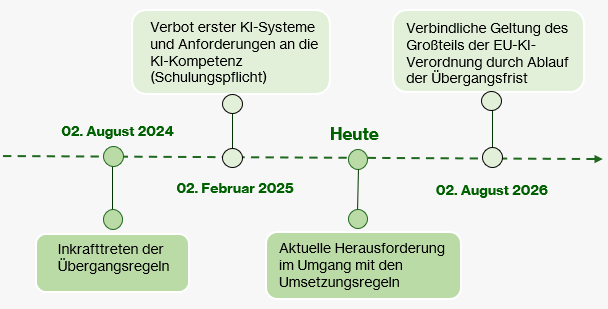
Key contents of the EU AI Act
- Scope of application: In addition to providers, operators (users) of AI systems are also affected – thus all companies are affected
- Basic training for employees on responsible handling of AI systems is mandatory from February 2025
- Obligation to document and assess risks of AI usage beyond the already established data protection (penalty up to 3% of turnover)
Options for action to implement
the regulatory requirements of the EU AI Act
Holistic implementation
of the EU AI Act

Efficient management of central AI system inventory
- Systematic identification and documentation of corporate AI systems
- Risk classification according to Art. 6 EU AI Act
- Regular proactive review of relevant changes (EU AI Act Compliance Audit)

AI system evaluation and monitoring
- Legal risk identification and assessment, as well as derivation of necessary measures
- Expert advice on risk-reducing measures (EU AI Act Compliance by Design)
- Legal expert review of the necessary AI system documentation depending on the risk classification

Required training and awareness raising
- Legally required AI compliance training for employees (on-demand)
- Advanced AI compliance training
- Provision of necessary internal guidelines for the use of specific AI systems and handling of AI systems

Expert hotline and proactive support
- eagle AI compliance experts for existing ad hoc inquiries
- Contract reviews from an EU AI Act perspective, integration into existing compliance processes
- Optional: Legal advice by specialized lawyers if needed

Certification support (optional)
- Comprehensive preparation for certification according to ISO 42001
- Software-supported internal audit (according to ISO 42001) by eagle experts
- External confirmation of AI compliance by eagle lsp
Selected software for efficient implementation of the EU AI Act
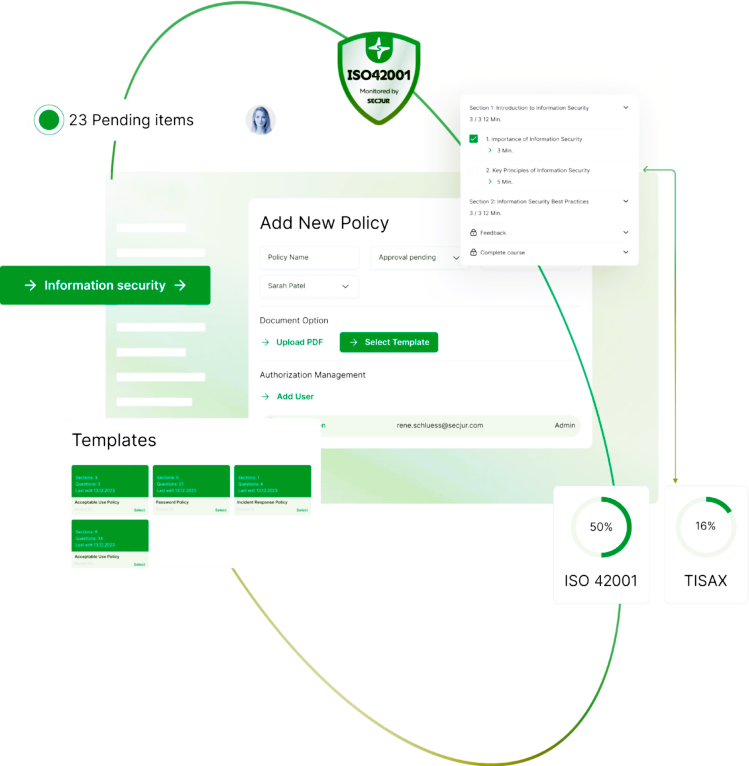
Software benefits: From the
documentation to the implementation of the EU AI Act
- Clear inventory and documentation of AI systems
- Structured risk identification and assessment (questionnaire)
- Storage of measures and policies
- Implementation of training requirements within the software
- System-based preparation for certification, e.g., ISO 42001
Live webinar
Fundamental requirements based on the EU AI Act
Webinar content
- Central AI system inventory: Transparency regarding internally used AI use cases and usage behavior, along with continuous monitoring of the use cases by compliance and clarification of roles.
- AI system assessment and monitoring: Risk classification of AI systems and identification of risk minimization approaches aimed at auditability.
- Awareness and training: Basic awareness about handling AI systems to establish clear guidelines for AI use in specific application cases.
The expert team behind EU AI Act Compliance as a Service

Antonia Amro
Compliance Services
| Legal Advisor
- Team lead Managed Compliance Services
- Lecturer Bucerius Compliance Officer

Jan Welle
Legal Monitoring
| Diplom Jurist
- 15+ years of process consulting and Managed Legal Services in Legal Tech
- Focus: Legal Monitoring, legal register, and AI Act compliance

Dr. Lasse Milinski
Head of Managed Solutions
| Dipl. ing. oec.
- 5 years in senior management at Serrala (FinTech)
- 6 years at McKinsey
EU AI ACT Compliant Badge
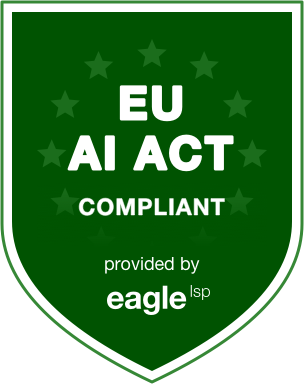
Provided by eagle lsp
- Utilize our private compliance badges for AI systems
- The badge is awarded after a review conducted by us according to the requirements of the EU AI Act
- It confirms that we have tested the AI system against the relevant legal and technical requirements
- After this review, our customers and partners can publish the badge on their own website and use it for communication purposes